

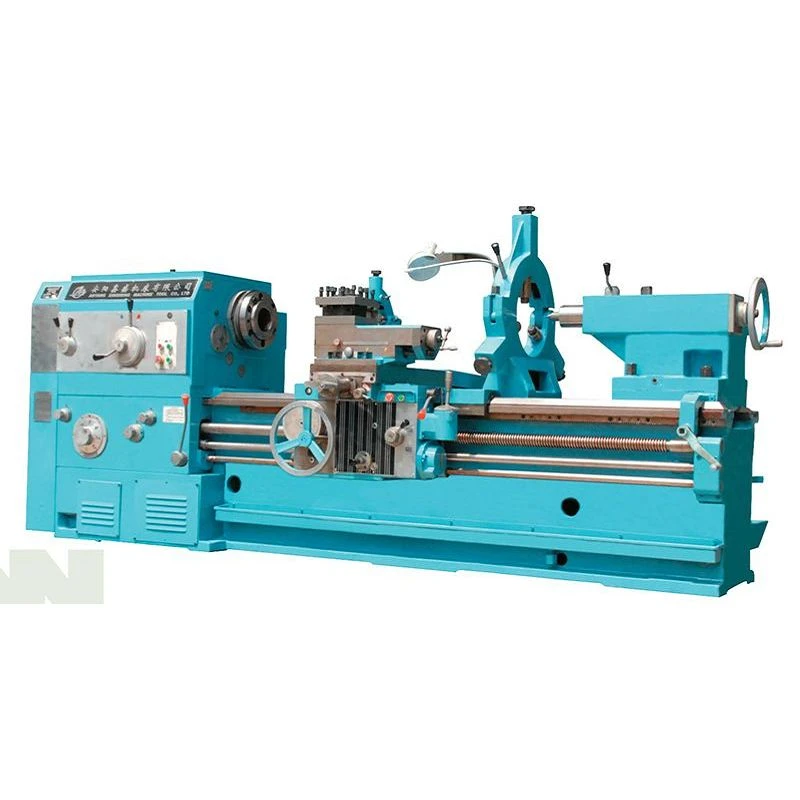


Product Overview
The Standard Horizontal Lathe is a conventional turning machine for machining shafts, sleeves, discs and other cylindrical metal workpieces. Its 800 mm swing, 100 mm spindle bore and turning lengths up to 5850 mm provide a broad working range for general-purpose turning, facing, boring, taper turning and threading.
Key Specifications
|
Parameter |
Specification |
|
Swing Over Bed |
800 mm |
|
Swing Over Carriage |
480 mm |
|
Maximum Workpiece Length |
1500–6000 mm |
|
Maximum Turning Length |
1350–5850 mm |
|
Guideway Width |
600 mm |
|
Spindle Nose |
C11 |
|
Spindle Bore |
100 mm |
|
Spindle Taper |
1:20 |
|
Forward Spindle Speed |
5.5–750 rpm |
|
Reverse Spindle Speed |
10–775 rpm |
|
Forward / Reverse Speeds |
18 / 6 |
|
Feed Rates |
64; 0.1–24.32 |
|
Metric Threads |
50 types; 1–240 mm |
|
Inch Threads |
26 types; 14–1 teeth/inch |
|
Module Threads |
53 types; 0.5–120 mm |
|
Diametral Pitch Threads |
24 types; 28–1 teeth/inch |
|
Tool Shank Size |
32 mm |
|
Tailstock Quill |
Ø100 × 250 mm, MT6 |
|
Main Motor Power |
11 kW |
|
Machine Weight |
4900–7500 kg |
|
Overall Length |
3670–8260 mm |
|
Overall Width × Height |
1450 × 1730 mm |
Large Workpiece Capacity
800 mm Swing Over Bed: Provides clearance for large-diameter workpieces mounted above the bed.
480 mm Swing Over Carriage: Defines the diameter clearance available over the carriage and should be checked against the workpiece diameter at the cutting position.
Long Turning Capacity: Available workpiece lengths from 1500 to 6000 mm and turning lengths from 1350 to 5850 mm cover different shaft and cylindrical-part sizes.
Workpiece Length Matching: The selected center distance should be based on the actual machined length, workholding arrangement and required tailstock support.
Stable Turning
Wide Guideway Support: The 600 mm-wide guideway provides a broad supporting surface for carriage movement under normal turning loads.
Rigid Bed Structure: The machine bed provides the structural support for the carriage, headstock and tailstock during conventional turning.
Controlled Feed Movement: The longitudinal and cross-feed system provides 64 feed selections, allowing the feed rate to be matched to different turning operations.
Wide Spindle Working Range
Large Spindle Bore: The 100 mm through-hole provides clearance for workpieces that extend through the spindle, which is relevant when machining longer shaft-type components.
Low-to-High Speed Coverage: The 5.5–750 rpm forward speed range covers low-speed turning as well as higher-speed conventional machining conditions.
C11 Spindle Nose: The C11 spindle nose defines the machine's spindle interface and should be confirmed against the required workholding arrangement before ordering.
Multi-Standard Threading
Metric Threading: 50 thread types from 1–240 mm cover a broad range of metric mechanical threads.
Inch Threading: 26 types from 14–1 teeth/inch support inch-based component requirements.
Module & Diametral Pitch: Module threads from 0.5–120 mm and diametral pitch threads from 28–1 teeth/inch support different gear and mechanical component requirements.
Tooling & Tailstock Support
32 mm Tool Shank Capacity: Supports conventional cutting tools used for turning, facing, boring and threading.
±90° Tool Post Swing: Allows the tool position to be adjusted for different turning and taper-machining conditions.
MT6 Tailstock Support: The Ø100 × 250 mm tailstock quill provides support for longer workpieces and uses a Morse 6 taper.
Applications
Shafts & Axles: Long shafts, stepped shafts and axle-type components requiring external turning, facing or threading.
Sleeves & Bushings: Cylindrical components requiring internal and external turning.
Flanges & Discs: Large-diameter rotary parts requiring face and outside-diameter machining.
General Mechanical Parts: Repair parts, replacement components and other conventional turned parts requiring flexible manual machining.
Pre-Shipment Testing
Acceptance Standard Reference: Machine acceptance references GB/T 4020-1997 for parallel-lathe accuracy and JB/T 2322-1993 for parallel-lathe terms.
Machine Function Check: Before shipment, the machine should be checked for the specified configuration and normal operation of the spindle, carriage and feed system.
Threading & Feed Check: Threading and feed functions should be verified against the ordered machine configuration before dispatch.
Final Pre-Packing Check: The machine configuration, external condition and supplied components should be checked before export packaging.
Logistics & Packaging
Export Wooden Case: The lathe is protected with export wooden-case packaging for overseas transportation.
Heavy-Machine Handling: With a machine weight of 4,900–7,500 kg, loading and unloading should be arranged with suitable lifting equipment.
Shipping Dimensions: Overall machine dimensions range from 3,670–8,260 mm in length, 1,450 mm in width and 1,730 mm in height, providing the basic information required for freight and site planning.
30–60 Day Delivery: Standard delivery is 30–60 days after order confirmation, subject to the final machine configuration and production schedule.
FAQ
Q: What information should I provide for a quotation?
A: Provide the workpiece drawing or dimensions, material, machining length, thread requirements and production quantity.
Q: What should I confirm for a specific workpiece?
A: Confirm the workpiece diameter, length, workholding method and required tailstock support before ordering.
Q: What electrical information is required?
A: Confirm the available voltage, frequency and three-phase power supply at the installation site.
Q: What should be prepared before installation?
A: Prepare a suitable foundation, lifting equipment, unloading access and sufficient installation space.
Q: What should be prepared for machine unloading?
A: Arrange lifting equipment suitable for the selected machine, which weighs 4,900–7,500 kg.
Q: What should be checked when the machine arrives?
A: Check the machine configuration, packaging, external condition, supplied components and documentation against the order.
Q: When should special requirements be communicated?
A: Communicate workholding, electrical and other configuration requirements during the quotation stage.
Producing Sight


Certification
Anyang XS small turning lathe design and produce according to the ISO 9001, ISO14001, we also owned the CE, UL certifications.

Exhibition

Hot Tags: standard horizontal lathe, China standard horizontal lathe manufacturers, suppliers, factory, horizontal lathe, Horizontal Lathe Machine, Horizontal Metal Turning Lathe, iron lathe, manual lathe, standard turning lathe